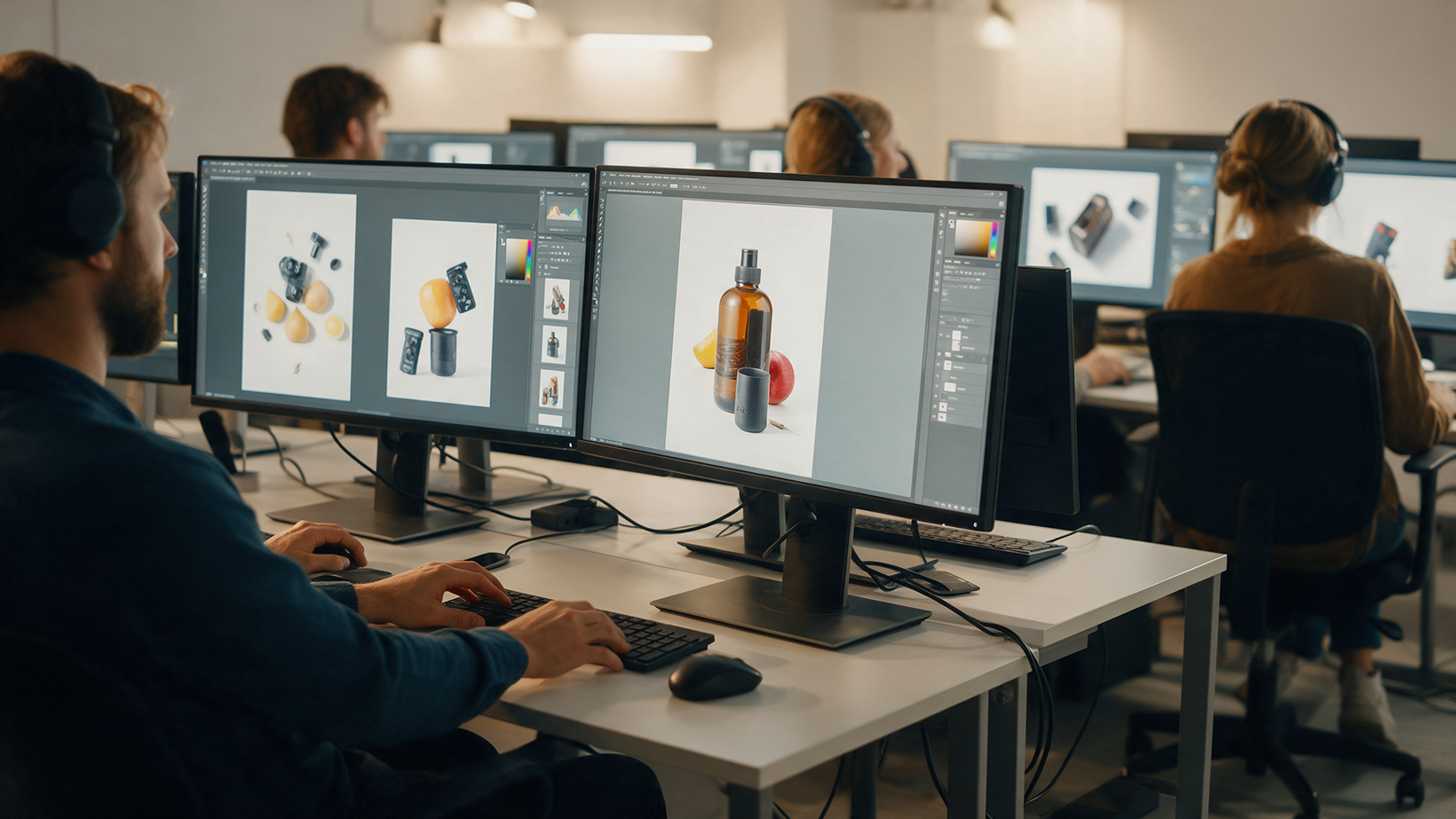
The shoot is done. Six hundred product images are sitting in a folder, waiting to be clipped, corrected, and delivered. The client's deadline is four days out. Your two in-house retouchers are still working through last week's batch.
Nothing about that points to a lack of work. If anything, it's the opposite problem: more images are arriving than your editing pipeline can absorb.
That distinction matters, because it changes the question. The usual framing is "should we outsource retouching?" A more useful one is:
Do you actually have an editing problem, or do you have a capacity problem?
Those call for different fixes. An editing problem gets solved by working faster or training people better. A capacity problem gets solved by adding flexible production capacity that expands and contracts with the workload, without permanently expanding the team.
This article walks through the actual math behind that decision: what in-house editing really costs once everything is counted, what outsourcing really costs once everything is counted, and how to tell which situation you're in.
The Cost You See Isn't the Real Cost
Most studios price in-house editing with one number: the retoucher's salary or hourly wage. That number is real, but it isn't the full cost.
The fuller list usually includes:
- Direct labor (wages and benefits)
- Editing software and licenses
- Hardware and calibrated monitors
- Workspace
- Management time spent assigning and checking work
- Quality-control passes
- Revision cycles when a client sends work back
- Overtime during busy weeks
- Administrative overhead (scheduling, invoicing, HR)
None of these show up as a single line item, which is exactly why they get left out of the comparison. Before deciding whether outsourcing is worth it, it's worth asking a sharper question than "is this cheaper":
What does keeping this work in-house actually cost, in total?
Calculate What One Editing Hour Really Costs
A simple way to get there:
True Hourly Cost = (Wages + Benefits + Software/Equipment + Workspace + Prorated Management & QA Time) ÷ Productive Editing Hours
Here's an illustrative version (not an industry benchmark, just a structure to plug your own numbers into):
- Loaded wage: $18/hour
- Software, equipment, and workspace, prorated: $3/hour
- Management and QA time, prorated (roughly 10% of editing time at a $30/hour manager rate): $3/hour
True hourly cost: roughly $24/hour. That's about a third higher than the wage figure alone. On a studio running 40+ editing hours a week, that gap compounds quickly, and it stays invisible until someone calculates it on purpose.
Then Calculate the Opportunity Cost
This is the part most in-house-vs-outsource comparisons skip, and it's usually the most important number in the decision.
Say a senior retoucher spends five hours this week on repetitive product retouching. The cost of that isn't just five hours of wages. The real question is:
What else could that person have been doing with those five hours?
Possibilities: working on a different client's project, prepping for a shoot, handling client communication, doing the complex retouching that actually needs their skill level, or taking on another billable task entirely.
This is opportunity cost, and it deserves to be treated precisely rather than romantically. It is not automatically five hours of new revenue. Freed time only turns into value if the studio actually redirects it toward something billable or otherwise useful. But it's real: a senior person's time spent on high-volume, low-complexity production work is time unavailable for anything else, and that has a cost even when it never appears on an invoice.

When Does Outsourcing Actually Make Financial Sense?
Not always. But it's worth evaluating seriously when:
- Image volume has jumped well above the normal weekly pace
- There's a large batch project with a fixed deadline
- The work is repetitive and production-oriented rather than creative
- Internal editors are already running near capacity
- The spike looks temporary or seasonal, not permanent
- Hiring a full-time editor for a temporary need would create fixed overhead that isn't wanted
- More capacity is needed without expanding the permanent team right now
If none of those apply (volume is steady, modest, and comfortably within what the team already handles), the math usually favors staying in-house. That's a legitimate answer too.
A Simple In-House vs. Outsourced Calculation
Here's one illustrative scenario: a batch of 500 standard product images needing clipping paths and basic color correction, averaging five minutes of editing time each.
| In-House | Outsourced | |
|---|---|---|
| Images | 500 | 500 |
| Editing time | ~42 hours | N/A |
| Direct labor (loaded rate) | $756 | N/A |
| Software/equipment/workspace | $126 | N/A |
| Management & QA time | $126 | $90 (review pass) |
| Opportunity cost (8 senior hours redirected) | $320 | N/A |
| Outsourcing fee (illustrative, $0.45/image) | N/A | $225 |
| Effective cost | ~$1,328 | ~$315 |
Two things worth saying about this table before it ends up in a pitch deck.
First, these numbers are illustrative, not a quote. Real outsourcing costs move with image complexity, rush turnaround, revision rounds, file prep, and any add-on services. A batch of clean product shots on white backgrounds prices differently than fashion images needing detailed masking or heavy retouching.
Second, this comparison assumes a studio that already has a workload problem, not every studio in every situation. At low volume, with simple work the existing team handles without strain, the in-house column shrinks and the case for outsourcing weakens. The math is workload-dependent, not universal, which is really the point of running it instead of assuming an answer.
What Should You Keep In-House?
A studio that outsources everything usually loses something that matters: consistency, brand voice, and quality control on the work that's actually creative rather than repetitive.
Better kept in-house:
- Creative direction and art direction
- Brand-sensitive decisions
- The studio's signature editing style
- Final creative approval
- Sensitive client communication
Reasonable to outsource:
- High-volume production retouching
- Repetitive image corrections
- Clipping paths and masking
- Background removal and replacement
- Batch color correction
- Standard product retouching
- Large-scale image cleanup
The dividing line isn't "cheap work vs. expensive work." It's repeatable production work versus judgment-dependent creative work. The first scales by adding hands. The second doesn't: it scales by protecting the time of the people who do it well.
What Happens When Outsourcing Becomes Part of the Workflow
In practice, this isn't usually a one-time decision so much as a workflow addition:
Brief → Reference images → Test batch → Production → QA → Delivery
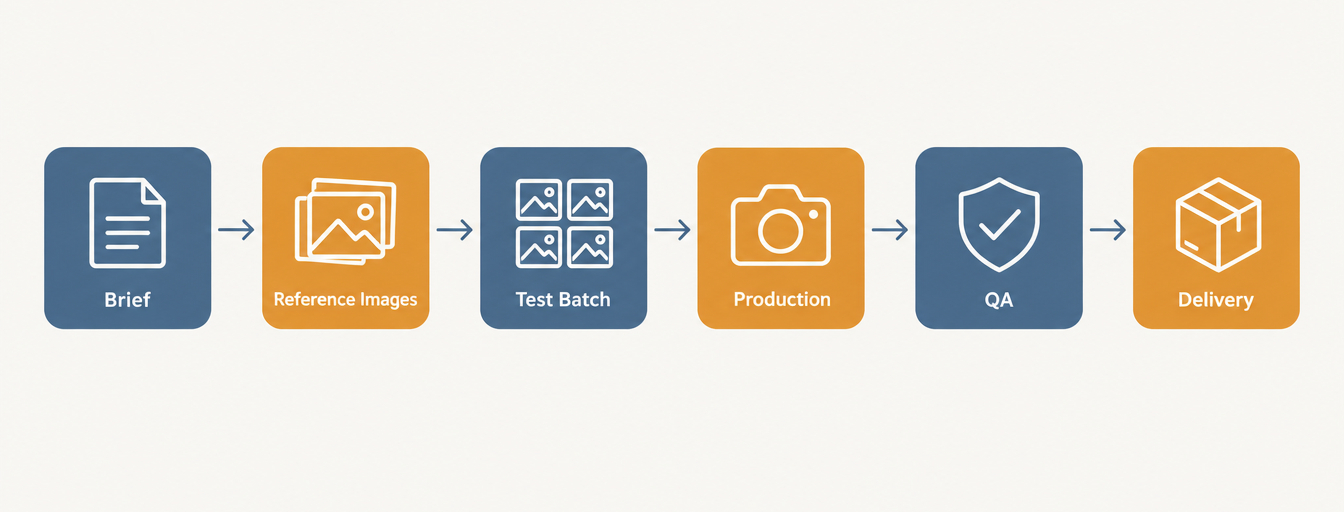
The brief and reference images set the standard: exact crop, color targets, file naming, background specs. A test batch checks whether an outside partner can hit that standard before any volume commitment. Production runs the bulk of the batch against the same instructions. QA (internal, external, or both) catches anything that drifted. Delivery comes back in the file structure the team already works in.
This is the point where a production partner like Clipping Path Service fits into the picture, not as a wholesale replacement for an in-house team, but as the flexible layer that absorbs repetitive volume so the in-house team's time goes toward the work only they can do.
Two Decades of Handling Exactly This Kind of Workload
The math above is deliberately generic: built to run against any studio's own numbers. But it's worth knowing what kind of partner is actually built to absorb the capacity side of that equation.
Clipping Path Service has operated as a production partner for photography studios, e-commerce teams, and creative agencies since 2005, a little over 21 years spent handling the exact pattern described above. That pattern: batches that arrive in uneven sizes, deadlines that don't move, and production teams that need more hands without a permanent headcount increase.
A few figures that speak to that longevity more directly than a tagline would:
- More than 78,000 projects delivered, each edited by hand rather than pushed through a fully automated pipeline
- Daily production capacity above 15,000 images: the kind of throughput that matters when a normal week and a seasonal-spike week look nothing alike
- A client base of photography studios, e-commerce production teams, fashion and product photographers, and creative agencies, working across roughly 35 countries
None of that guarantees a fit for any specific studio's workflow or budget. That's exactly what the math above is for. But it does mean the volume swings and deadline pressure described in this article aren't an edge case for a partner like this one. They're the daily baseline the model was built around.
Start With the Numbers, Not a Commitment
The honest way to answer "should we outsource retouching" isn't a gut call. It's running the calculation above with real hours, real rates, and a real look at opportunity cost.
If the math looks close, or the assumptions feel shaky, the lower-risk next step isn't a contract. It's a small test batch: send a handful of real images, check the turnaround and quality against an existing standard, and compare the result to what those same images would have cost to edit in-house.
Clipping Path Service offers exactly that kind of no-commitment starting point: three images edited free, delivered within 24 hours, no card required, enough to check quality and turnaround before any volume decision gets made.
Run the numbers first. Test the model second. Decide third.
Ready to Run the Test Batch?
Send a handful of real images from a recent project and compare the result (turnaround, quality, and cost) against your own in-house numbers.