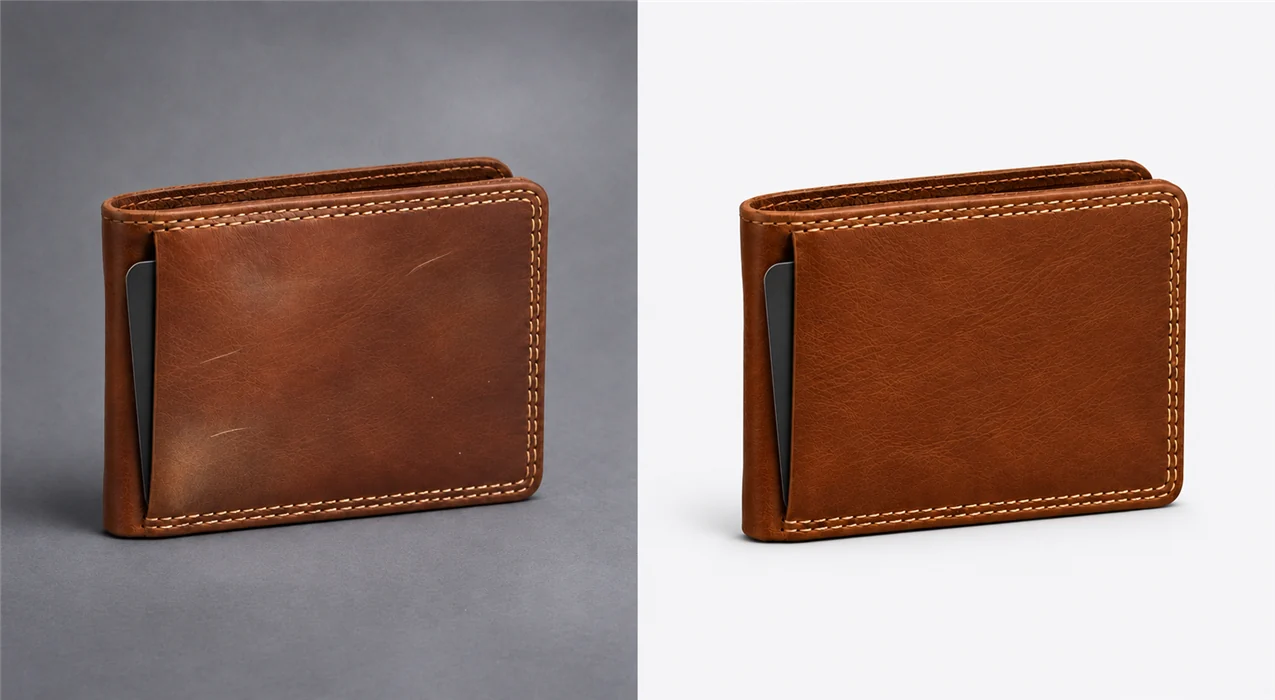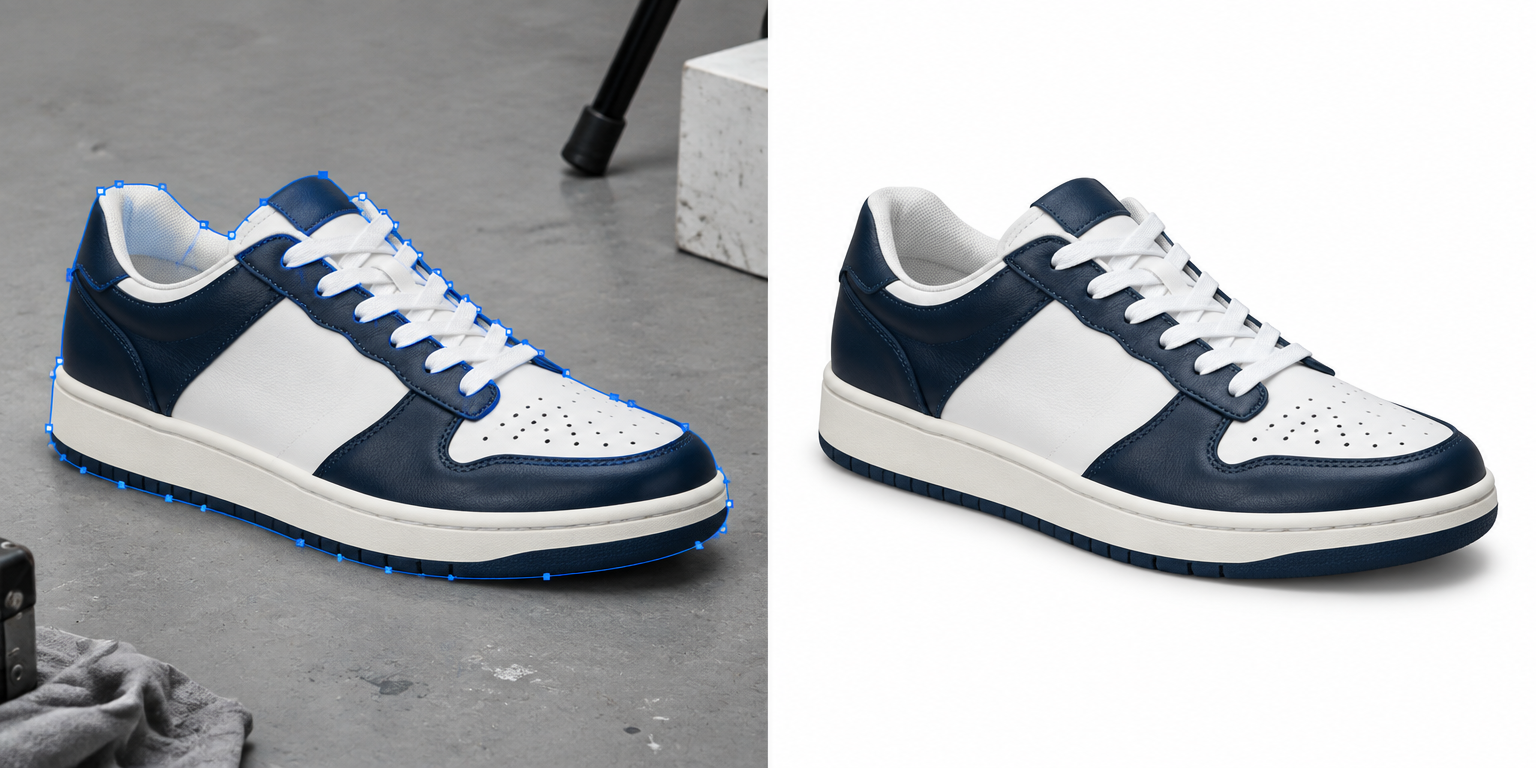
Illustration: a Medium-tier product, before (with the path outline) and after.
A clipping path service costs $1 to $16 per image. The price depends on how complex the image is, how many images you send, and how fast you need them back.
That is the short answer. The useful answer is how to work out your own number before you send a single file.
ClippingPathService.com has been hand-cutting images for eCommerce brands, photographers, studios, and agencies for more than 25 years. This guide explains how our pricing works, so you can budget with confidence, compare vendors fairly, and avoid a surprise invoice.
The Quick Price Table
Here are our current per-image rates. For the latest version, see our pricing page.
| Complexity | Price per image | What it looks like | Typical products |
|---|---|---|---|
| Easy | $1.00 | One object, smooth outline, no holes | Boxes, phones, bottles, plates |
| Medium | $3.00 | Several curves, a few inner gaps | Shoes, bags, watches, apparel |
| Complex | $5.00 | Many paths, fine detail, multiple holes | Jewelry, bikes, furniture, groups |
| Super Complex | $16.00 | Hundreds of anchor points | Chains, mesh, foliage |
| Flat Rate Bulk | $2.50 | Mixed easy, medium, and complex batch at one price | Catalogs of 100+ images |
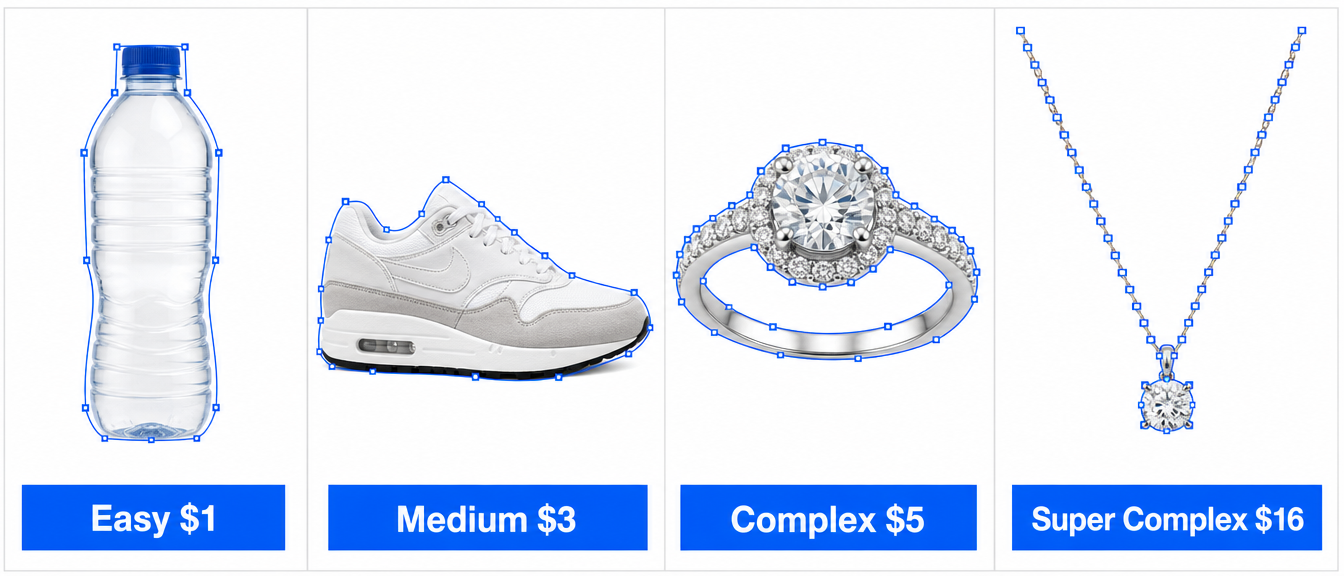
Illustration: complexity sets the price. Easy $1, Medium $3, Complex $5, Super Complex $16.
There is no minimum order. Revisions cost nothing extra, and JPG, PNG, PSD, and TIFF files are included.
Now let's look at why one image costs $1 and another costs $16.
How Clipping Path Pricing Works
Your price is built from four factors. They do not all apply to every order, so here is how they fit together:
Total cost = image rate + add-ons, then apply any applicable turnaround surcharge or volume pricing.
1. Image complexity (sets the image rate)
A clipping path is a vector outline drawn point by point around your product. More curves, more holes, and finer edges mean more anchor points and more editor time.
A water bottle needs a clean, smooth outline. A chain necklace needs hundreds of precise points, and every gap between links needs its own path. That is why they sit in different tiers.
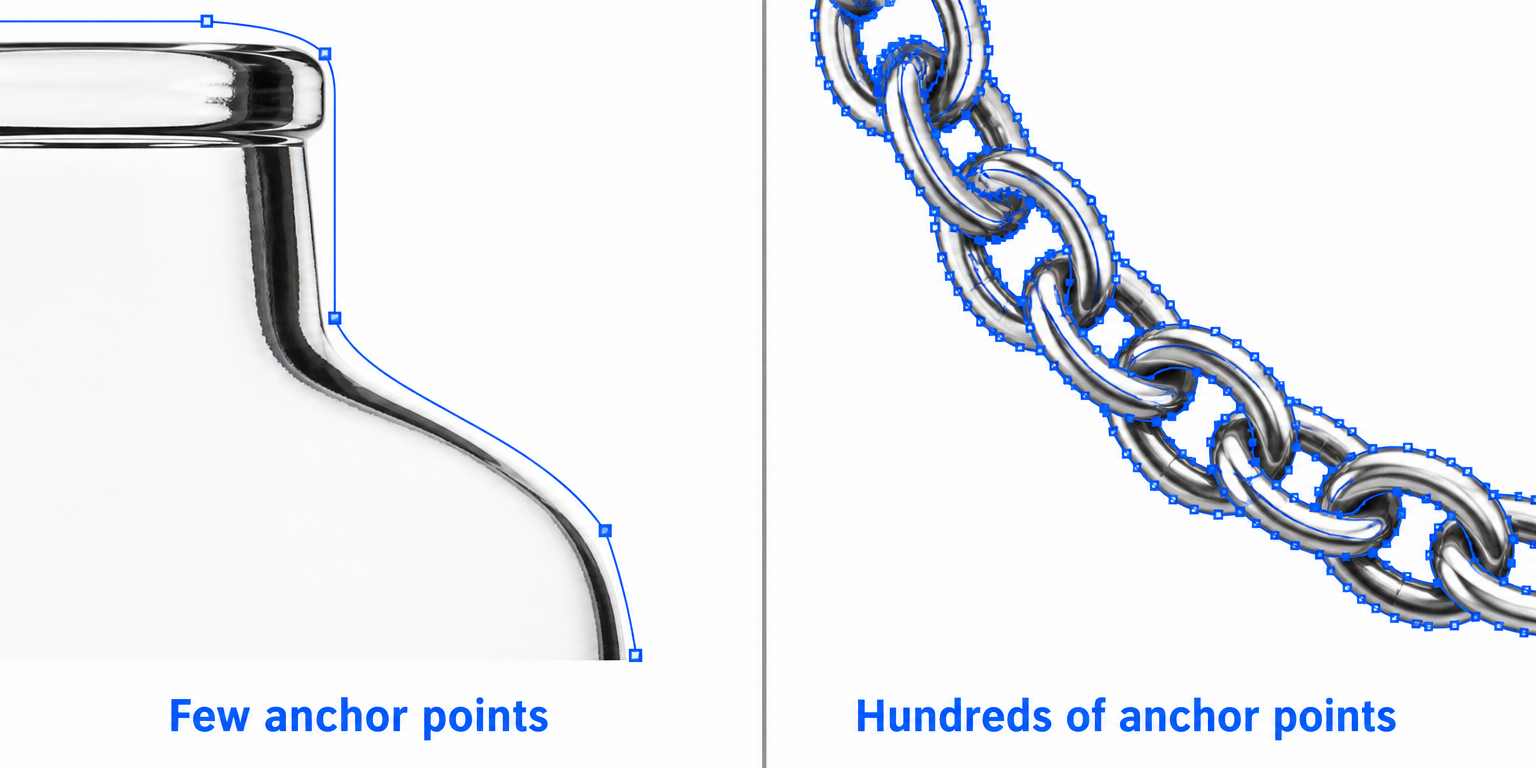
Illustration: more anchor points mean more editor time, and a higher tier.
2. Volume (three separate options)
Volume does not adjust every order automatically. There are three distinct ways to price it:
- Standard per-image pricing. Each image is priced by its tier: Easy, Medium, Complex, or Super Complex.
- Flat-rate bulk option. For mixed batches of 100+ images, you can choose one price of $2.50 per image, so you do not have to sort files by tier.
- Custom volume pricing. For recurring volume of 500+ images a month, we price your account on a production call.
Is the flat rate always cheaper? No. It depends on your mix. Here is an illustration:
- 400 images: 250 Easy, 100 Medium, 50 Complex. Standard pricing is $250 + $300 + $250 = $800. The flat rate would be 400 x $2.50 = $1,000.
- 300 images: 100 Easy, 100 Medium, 100 Complex. Standard pricing is $100 + $300 + $500 = $900. The flat rate would be 300 x $2.50 = $750.
Illustrative calculations based on published rates, not client invoices.
The rule of thumb: the more complex images in your batch, the more the flat rate helps. A batch that is mostly Easy is usually cheaper at standard rates.
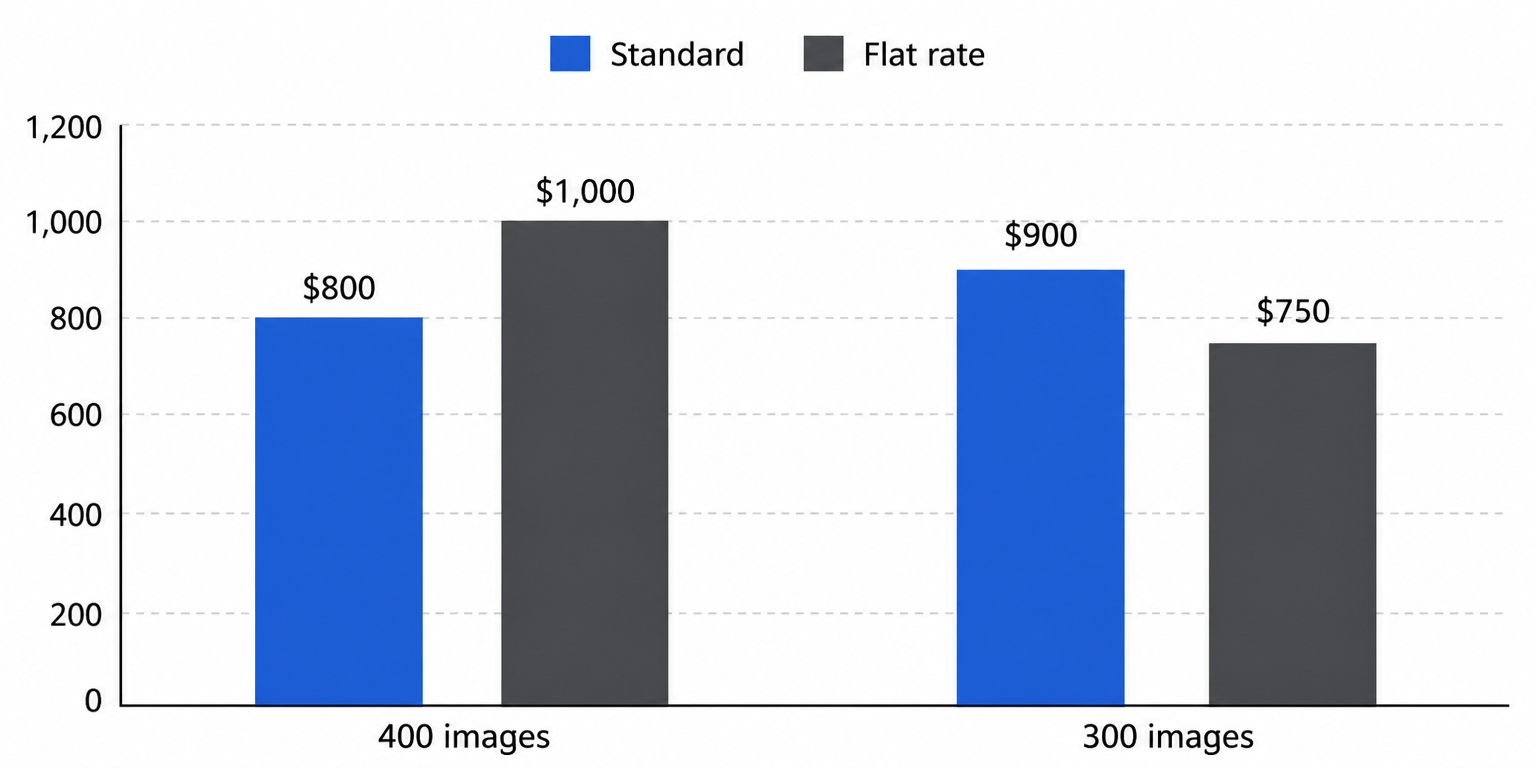
Illustrative calculation based on published rates, not client invoices.
3. Turnaround (sets the surcharge)
Standard delivery is included in the price. Speed is what adds cost.
| Turnaround | Surcharge | Example on a $3 Medium image |
|---|---|---|
| 48 hours | Included | $3.00 |
| 20 hours (overnight) | Included | $3.00 |
| 10 hours (prompt) | +70% | $5.10 |
| 4 hours (express) | +200% | $9.00 |
| 1 hour (rush) | +300% | $12.00 |
If your deadline is flexible, the 20-hour overnight option gives you next-day delivery with no premium.
4. Add-on services
Some jobs need more than the cutout. Add-ons are priced per image.
| Add-on | Price per image |
|---|---|
| Drop shadow | +$0.50 |
| Keep original shadow | +$0.50 |
| Crop and resize | +$1.00 |
| Retouch and optimize | +$1.00 |
Worked Example: Add-On Plus Rush Delivery
Here is how the pieces combine for a real-world style order.
Scenario: 300 Medium images (shoes), with crop and resize, needed in 10 hours.
| Step | Calculation | Amount |
|---|---|---|
| Image work | 300 x $3.00 | $900 |
| Crop and resize | 300 x $1.00 | $300 |
| Subtotal | $1,200 | |
| 10-hour turnaround | +70% of $1,200 = $840 | +$840 |
| Total | $2,040 |
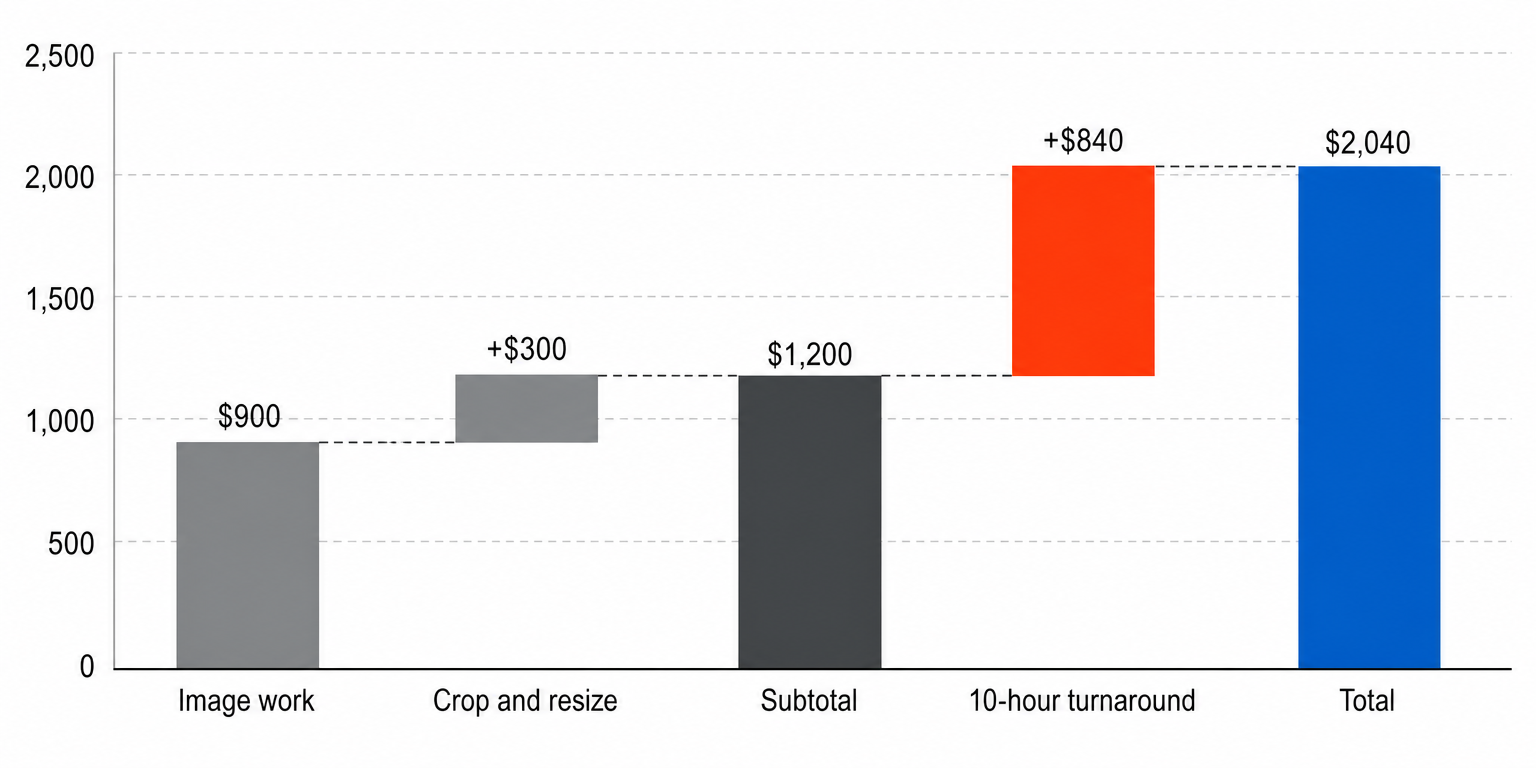
Illustrative calculation based on published rates, not a client invoice.
The same order at 48-hour or 20-hour delivery would be $1,200. In this example, the 10-hour deadline adds $840.
The example applies the surcharge to the full subtotal. Confirm how the surcharge applies to your add-ons when you request your quote.
A simple estimate for a quick project: 150 Easy bottle images with a drop shadow at standard delivery is 150 x $1.00 = $150, plus 150 x $0.50 = $75, for a total of $225.
The Hidden Costs of a Clipping Path Order
The per-image rate is only part of what an order costs you. Before you compare quotes, check for these.
- Rework. If edges need fixing after delivery, either you resubmit or your team cleans them up. Both cost time.
- Inconsistent batches. If edge quality varies from the first image to the last, your catalog looks uneven and someone has to find and fix the outliers.
- Revision policy. Ask whether corrections are included or charged per image. At ClippingPathService.com, revisions cost nothing extra.
- File format fees. Ask which formats are included. PSD and TIFF matter if your team edits further.
- Rush fees. Get the surcharge for your deadline in writing before you agree to it.
- Internal cleanup time. Every hour your editor spends checking and correcting outsourced files is an hour not spent on other work.
A better question than "What is the price per image?" is "What will my total be, including revisions, formats, and my real deadline?"
What 25+ Years of Production Tells Buyers About Clipping Path Cost
After more than 25 years and 78,066+ projects for 450+ brands and retailers, a few patterns show up in how clipping path work turns into cost. They apply whichever vendor you choose.
Manual work costs more per image, and it shows up on difficult products. Every image at ClippingPathService.com is edited by hand. Reflective metal, fine chains, mesh, and foliage take far more anchor points and editor time, which is why they sit in the higher-priced tiers.
Batch consistency is part of the price you are paying for. A single clean cutout is easy to judge. The real test is whether image 400 matches image 1. Inconsistency creates review and cleanup work on your side.
QA takes time, and time is a cost. We use a 3-step quality control process with a person checking before delivery. Ask any vendor what checks happen before files reach you, because those checks decide how much of the review work lands on your team.
Deadlines drive cost more than most buyers expect. Turnaround is the one factor you control directly. A 48-hour or 20-hour delivery adds nothing. Planning a batch one day earlier can save the 70% to 300% rush premium.
Proof Example: What a Complex Batch Looks Like
To see how complexity, QA, and deadlines connect to cost, consider a project we delivered for a US-based jewelry eCommerce brand.
The brief was 1,200 jewelry product images in 4 business days. Fine chains and reflective metal put many of them in the higher-detail tiers.
The outcome:
- 1,162 of 1,200 images (96.8%) were approved in the first round.
- 38 images were flagged and re-delivered the same evening.
- The batch was delivered 14 hours ahead of the deadline.
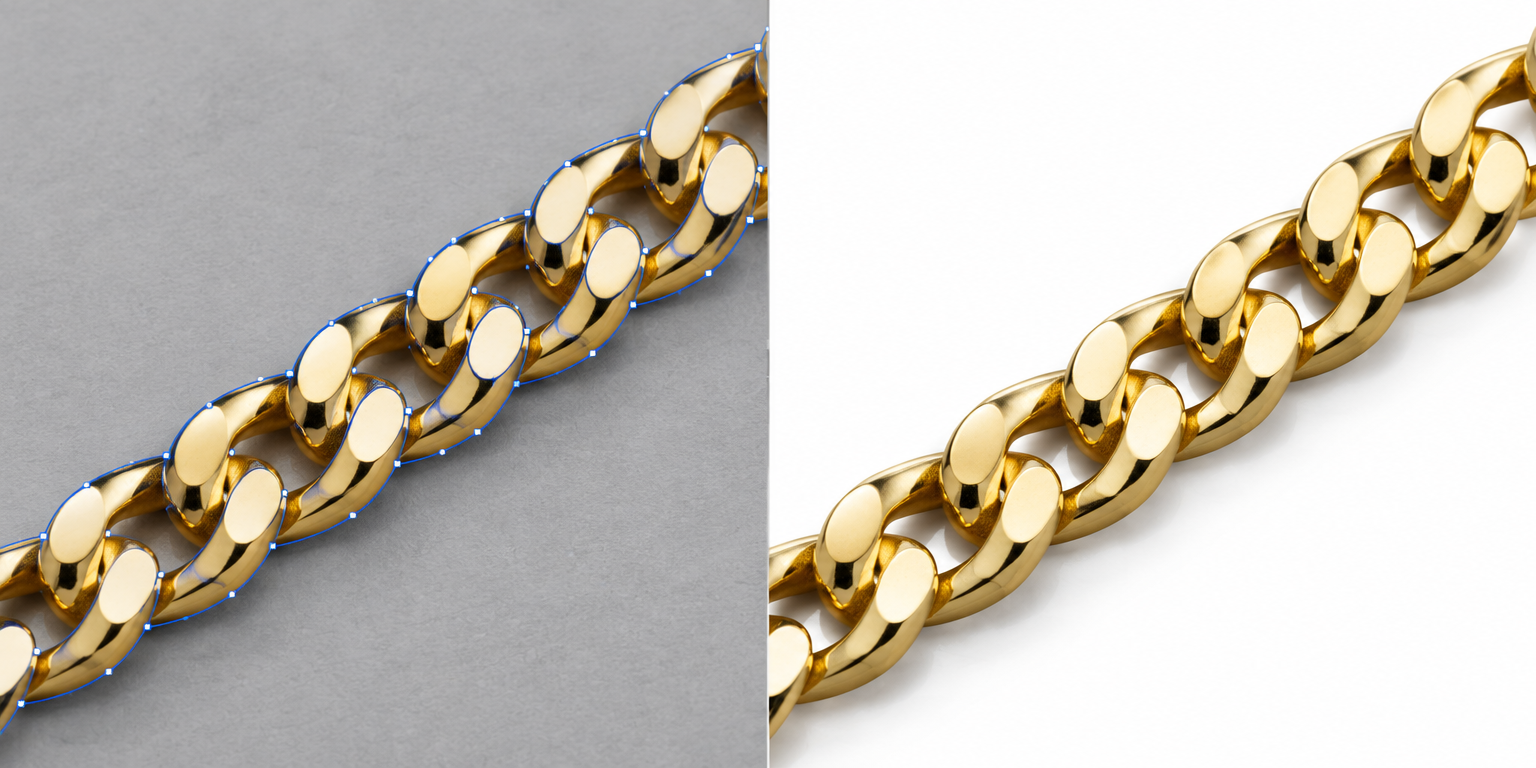
Illustration: fine chain detail, before and after a clipping path.
Why this matters when you compare prices: on a batch this size, even a small first-round miss rate is a lot of files to fix. Here, that was 38 images out of 1,200. The per-image rate tells you what you pay upfront. The first-round approval rate tells you how much correction work follows.
Want the full story? Read the complete 1,200-image jewelry case study. For jewelry pricing specifically, see our jewelry editing page.
How to Compare Clipping Path Vendors Fairly
Use this checklist when you collect quotes.
- Is the price tied to complexity? Ask how each of your product types would be classified.
- What does rush delivery cost? Get the exact surcharge for 10, 4, and 1 hours.
- Are revisions included?
- Which file formats are included?
- Is there a minimum order?
- Is every image checked by a person before delivery?
- Can you test the service first?
- What happens to your files afterward? We permanently delete images after the project unless you ask us to keep them.
Outsource or Keep It In-House?
Compare the outsourced price with your own editor's time.
Illustration: If an editor averages 4 minutes per Medium image, 300 images require about 20 hours of editing time. This is an example only, not an industry benchmark. Use your own editor's real average.
At $3.00 per image, 300 Medium images cost $900 to outsource. The question is whether 20 hours of your editor's time is worth more or less than that, and what else that editor could be doing.
Outsourcing tends to make sense when you have:
- Batches over 100 images
- Recurring launches or seasonal drops
- Hard-to-cut products such as jewelry, mesh, or fur
- Deadlines your team cannot absorb
Keeping it in-house tends to make sense when you have a handful of simple images each month and an editor with spare hours.
Frequently Asked Questions
How much does a clipping path cost per image? Prices range from $1.00 to $16.00 per image, depending on complexity. Easy is $1.00, Medium is $3.00, Complex is $5.00, and Super Complex is $16.00. Add-ons and faster turnaround are charged on top.
Why do clipping path prices vary? The price follows the amount of hand work an image needs. A smooth-edged box needs few anchor points. A chain, mesh, or foliage needs hundreds. Turnaround speed and add-ons such as shadows or resizing also change the total.
How much does a simple clipping path cost? A simple clipping path (one object, smooth outline, no holes, such as a box, phone, or bottle) is $1.00 per image.
How much does a complex clipping path cost? Complex images with many paths, fine detail, and multiple holes, such as jewelry, bikes, or furniture, are $5.00 per image. Super Complex images with hundreds of anchor points, such as chains, mesh, or foliage, are $16.00.
Is clipping path pricing cheaper for bulk orders? There is a flat rate of $2.50 per image for mixed batches of 100+ images. It is not always cheaper than standard tier pricing, so compare using your own image mix (see the examples above). For recurring volume of 500+ images a month, we set up custom pricing on a production call.
Does rush delivery cost extra? Yes for faster options. 48-hour and 20-hour (overnight) delivery are included. 10-hour delivery is +70%, 4-hour is +200%, and 1-hour is +300%.
Are revisions included? Yes. Revisions cost nothing extra. JPG, PNG, PSD, and TIFF file formats are also included.
How do I know which pricing tier my images fall into? Match your product to the tier descriptions in the price table: the number of curves, holes, and fine details decides the tier. If you are unsure, include a few sample images when you request a quote.
Can I get a free clipping path sample? Yes. Send 3 images and we will edit them free, no card required. You can start on our free trial page.
Get Your Exact Price Before You Commit
You now know how the price is built. The fastest way to know your own number is to see your images cut.
Send 3 images and we will edit them free. No credit card required. No minimum order. Revisions included.
Test Us on 3 Images, Pay Nothing
Request a quote with your image count, image types, and deadline to get a total you can take to your manager or client. Recurring volume of 500+ images a month? Book a production call and we will price your account.
P.S. If your deadline is close, choose 20-hour overnight delivery. It is included in the base price, so you get next-day files without a rush fee.